Belaying
Prices and Availability of All Items Are Subject
to Change Without Notice
Belaying is a means of protecting a climber, rappeller, worker or litter (and attendants) from falling. Ideally, the belay device or hitch should be securely attached to a bombproof anchor which is separate from the standing line anchor. The belayer should not use his body in the belay system if there is any way to avoid doing so. Occasionally, this rule may have to be violated, however, be aware that both the climber and belayer have a much greater risk of severe bodily harm or even death when utilizing a body belay. A severe fall by the climber may cause back or internal injuries to a body belayer due to the sudden load which may be imparted to the belayer during a fall. It is also possible to knock the belayer’s feet out from underneath him during a fall, thereby allowing the climber to fall. If at all possible, keep the belayer’s body out of the belay system. This greatly reduces the chance of a mishap occurring. Belaying should be performed with a suitable belay device or with a Munter Hitch, not your body.
Remember that most belay devices are very sensitive to changes in rope diameter or construction. What works good on a 10mm rope may not work as well on a 11mm rope, or from one manufacturer’s rope to another. Know your equipment and what works together best. Ultimately, it is the user’s responsibility to seek out proper instruction and to practice safe climbing techniques.
Falling while climbing is extremely dangerous. All belay devices, hitches or methods should be considered as a last resort that may help you to survive a fall. However, no belay method, device or hitch can absolutely guarantee your safety in a fall.
CMI
Micro Belay Brakes
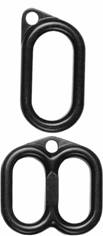
· Breaking strength 6,000 lbs.(2722kg)
· Weight dual .37oz.(11g)
· Weight Single .25oz.(7g)
· Lightweight
· Forged from 7075 aluminum
· Designed for one person load
· Made
in
Catalog #MBP101 Dual 9mm Micro Belay Brake
Catalog #MBP102 Single 11mm Micro Belay Brake
Conterra
SCARAB
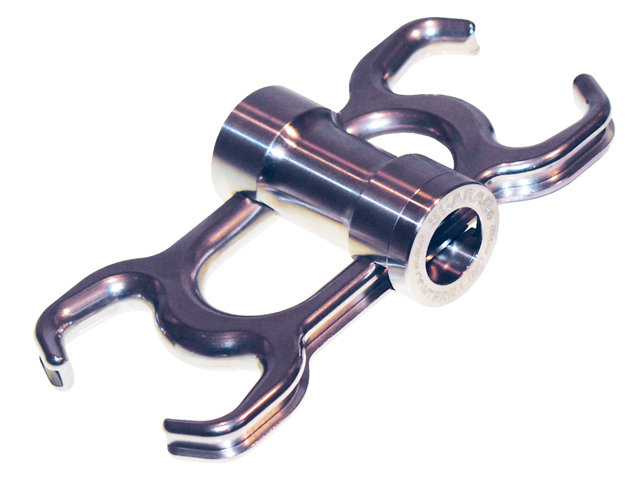
This device will absolutely change the way you perform rope rescue. The
SCARAB was born out of the need for a small, simple device that could easily
control heavy rescue loads, as well as excel at pick offs, twin rope systems
and other general rescue techniques. The SCARAB does all this and more. With
two models available, the SCARAB is the perfect choice for both Fire/Rescue and
back country rescue environments.
Features:
• Incredibly strong ( Frame and crossbar’s strength is greater than 40kN)
• Does not twist the rope
• Instantly adjustable friction (just wrap a horn)
• Lower 600 lb loads with two fingers
• Super easy lock off
• Easy to use, right or left handed
• Single and double rope capable
• Attach rope without unclipping from anchor
Catalog #16-SFR1 Scarab Fire/Rescue (Stainless Steel)
·
Ultra versatile general rescue tool
·
Machined from solid 303 stainless plate
·
Works with 9mm to 13 mm rope
·
Weight: 385g (13.8 oz)
·
MEETS NFPA 1983
(06 ED) “G” (general use) For 12.5mm rope
Catalog #16-STI1 Scarab Ti Mountain Rescue (Titanium)
·
Ultra light alpine rescue
tool
·
Machined from solid Titanium plate.
·
Works with 6mm to 11 mm rope.
·
Weight: 185g (6.6 oz)
Petzl
Grigri 2
|
Petzl Grigri
2 |
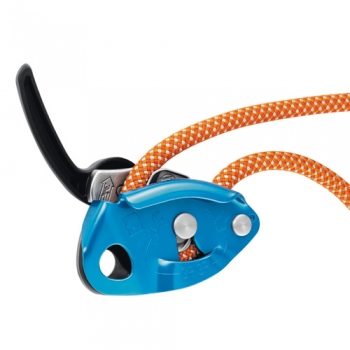
The GRIGRI 2 belay device with assisted braking is designed to facilitate belay maneuvers. The GRIGRI 2 works equally well for lead climbing and top roping. It may be used on all single dynamic 8.9 to 11 mm ropes on the market (ideal at 9.4 mm to 10.3 mm). Both compact and ultra-light, the GRIGRI 2 will accompany you on climbs around the world for many years. The GRIGRI 2 has a new design that allows excellent control during the descent.
- Belay technique identical to classic belay systems: both hands on the rope. A fall is stopped by tightening the hand on the free end of the rope.
- Assisted braking capability: during fall arrest, the belayer holds the free end of the rope, the cam pivots and pinches the rope, increasing the braking action until the rope stops sliding.
- The GRIGRI 2 has a new design that allows excellent control during the descent. One hand holds the rope and the other uses the handle to unlock the cam. The patented handle design allows a very gradual release of the rope. In combination with the strong braking action of the cam, it gives a great feeling of control when lowering a partner or rappelling.
- The GRIGRI 2 is compact and ultra-light at 185 g (25 % smaller and 20 % lighter than the GRIGRI)
- The construction includes a stainless steel friction plate and cam to ensure a long life for the product
- For 8.9 to 11 mm single ropes (ideal at 9.4 to 10.3 mm)
- Diagrams for rope installation engraved on belay device (interior and exterior)
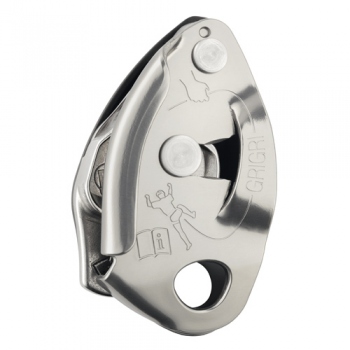
Catalog #D14 2G Grigri 2 - Gray
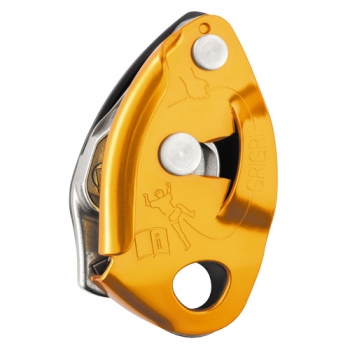
Catalog #D14 20 Grigri 2-
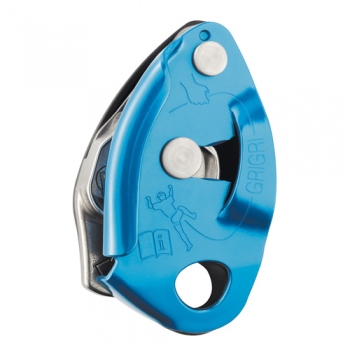
Catalog #D14 2B Grigri 2 - Blue
I’D L
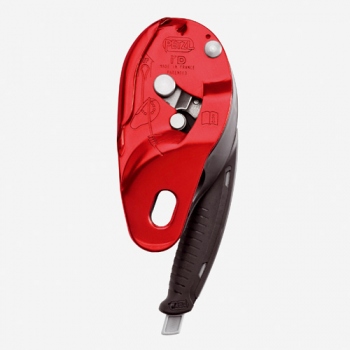
Self-braking
descender with anti-panic function for rescue
- Designed for rescue: lacks a gate
- Multi-functional handle
allows the user to:
- unblock the rope and control the descent with the hand on the braking side of the rope
- move more easily on horizontal or low-angle terrain thanks to the button on the handle
- to position himself while on the rope - Anti-panic function is engaged if the user pulls too hard on the handle: the pivoting cam is released and automatically brakes to stop the descent
- Anti-error safety cam to reduce the risk of an accident due to incorrect installation of the device on the rope. The shape of the cam is designed to improve rope glide during an ascent.
- Pivoting cam makes it easier to take up the slack in the rope Can also be used to make a reversible haul system, and for short ascents (in conjunction with a FOOTPRO footloop and an ASCENSION handled rope clamp).
- Weighs 530g
- For ropes 11.5-13mm in diameter
Catalog #D20 L
I’D S
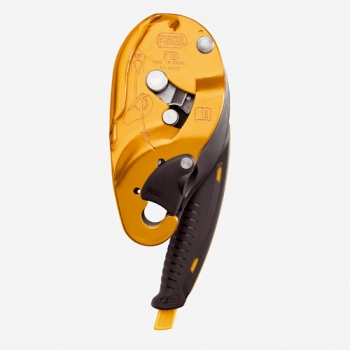
Self-braking
descender with anti-panic function for working on fixed ropes
- Designed for work on a rope: the gate on the swinging side plate helps prevent dropping the device
- Multi-functional handle allows the user to:
- - unblock the rope and control the descent with the hand on the braking side of the rope
- - move more easily on horizontal or low-angle terrain thanks to the button on the handle
- - to position himself while on the rope
- Anti-panic function is engaged if the user pulls too hard on the handle: the pivoting cam is released and automatically brakes to stop the descent
- Anti-error safety cam to reduce the risk of an accident due to incorrect installation of the device on the rope. The shape of the cam is designed to improve rope glide during an ascent.
- Pivoting cam makes it easier to take up the slack in the rope Can also be used to make a reversible haul system, and for short ascents (in conjunction with a FOOTPRO footloop and an ASCENSION handled rope clamp).
Catalog #D20 S
Rock Exotica
Soloist
The Soloist is designed to
provide, in conjunction with a backup knot, a means of self belay for the solo
climber. The rope feeds through the Soloist automatically as the climber
advances. It will handle a very hard fall and it is easy to back up. Includes a
comprehensive 16 page instructional booklet which describes how to use the
Soloist for top roping, lead climbing, falling on the Soloist, falling on your
backup and rappelling. Made in
· Breaking strength 5000 lbs.(2267kg)
|
Rock Exotica
Soloist |
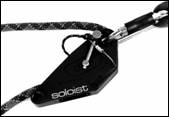
· Each tested to 2000 lbs.(907kg)
· Weight 10oz.(285g)
· Rope size 3/8”(10mm) to 7/16”(11mm), lead rope
· Machined, no castings
· Color - Red
Catalog #Soloist
Rock Exotica
Solo-Aid
|
Rock Exotica Solo-Aid |
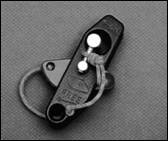
Similar in function to the Soloist, but with an important difference. With the Solo-Aid, the user must manually feed the rope through the device as height is gained in the climb. While this requirement might seem to be a drawback, a benefit of the design is the Solo-Aid’s ability to lock even when inverted. A head-first fall with the Soloist is extremely dangerous as the rope simply slides through the device, possibly allowing the climber to hit the ground. Note: This is not a device for novice climbers, it requires a strong understanding of the advanced rigging techniques used in modern rock climbing. Weight 6.6oz.(189g).
Catalog #302140 Solo-Aid